
Homesick
The Ache Beneath the Surface
There are aches that never go away because they don’t come from a moment — they come from a lifetime. This chapter is about the longing I carried for a kind of love, safety, and togetherness that I had never known but somehow always ached for. It’s about the unseen toll of growing up without a grounded sense of family, structure, or consistent nurture. It’s about the envy I felt for the people who had what I only imagined, and the healing that began when I stopped shaming myself for that ache and started tracing it to its source.
Storytime
I’ll never forget the day I watched a father and daughter playing together at the beach. They were laughing in the shallow water as the sun began to dip, the waves rolling in like background music to their joy. I teared up suddenly, feeling a lump in my throat. That scene cracked something open in me. Not because I missed something I once had, but because I missed something I never did.
Then there was a visit to a friend’s family home in L.A. Her mother’s house was warm, organized, filled with memories, photos, and presence. The fridge was full. Her mom served us food while her dad came in from walking the dog and said, “Honey, I’m home.” They had a system, a flow — something built. I started sobbing without warning. My friend held me, understanding that what I was mourning wasn't what happened — but what never had.
Even in adulthood, I have moments where I feel out of place among people who talk about their childhood homes with warmth, or parents they can rely on. I feel compassion when they share their pain, but when they also have stability or support systems, it stings. It exposes that deep ache in me. The ache for what was missing.
Conditioning: Why We Numb the Ache
When we grow up with chronic emotional deficits — with caregivers doing their best while emotionally dysregulated, overwhelmed, or unavailable — our nervous system adapts to protect us. In psychology, this is known as adaptive conditioning. We learn to mute our needs to avoid further pain, to earn love by minimizing ourselves.
As a child, I learned my feelings were “too much.” On top of my mom’s unprocessed trauma, my emotions were extra weight. I watched her juggle work, survival, and motherhood with a courageous but chaotic heart. She had a massive capacity to love, but her trauma lived in her body. She parented with sheer willpower, but her nervous system was often in overdrive. Her body was trapped in trauma, and we moved with her.
To survive emotionally, I trained myself to disappear. I became agreeable. Quiet. I taught myself not to cry. My therapist helped me uncover that I would literally bite my inner gum or pinch myself when I felt tears coming on — punishment for feeling too deeply. I carried that into adulthood. This wasn’t because I lacked emotional depth — it was because I’d never learned emotional safety.
Conditioning happens when the body and brain repeatedly experience something and draw a survival-based conclusion: “This is what keeps me safe.” Even if the “safe” is silence. Or pretending we don’t long. Or hating others for what we don’t have.
Spiritual & Physical Parallel: The Phantom Limb Syndrome
Phantom Limb Syndrome — a condition where a person feels pain or sensation in a limb that has been amputated. It’s the body’s memory of something that was once part of it — or should have been.
This is what it felt like. Like a limb I was born expecting but never developed. A missing father. A grounded home. A structure of safety. And yet I felt its absence like a real, living pain.
Spiritually, this is what covetousness is often rooted in: the haunting of what we believe should’ve been ours. Not because we are greedy or shallow — but because we are grieving something we never had the language to mourn.
The Poison of Comparison
Comparison numbs gratitude. When we fixate on what others have — especially when it’s what we lacked — we miss the blessings in our own becoming. Jealousy corrupts clarity. It can turn empathy into resentment, and awareness into paralysis. When left unhealed, it blinds us to what God is doing now — in us, through us, and for us.
I’m still learning to correct this thinking as it arises. To pause when my envy flares and ask: what does this envy reveal about my deepest longing? What does it say I still need to grieve, release, or bring to God?
Grace for My Mother, Grace for Myself
My mother, like many mothers, did everything she could. She loved us with all she had, and suffered deeply from unspoken trauma, mom guilt, and limited tools. Her love was massive. Her intent was to serve and protect. But her body was tired, and her nervous system wired for survival.
Now, I see her more clearly. Not just as my mother — but as a woman who inherited pain and did her best to transform it with limited resources. Her capacity for order was capped by her pain. And I honor her for what she gave.
From Ache to Acceptance
Gratitude isn’t ignoring the ache. It’s letting God meet us there. It’s letting Him fill the space with a new inheritance: the safety, love, and belonging we longed for — in Him.
Healing isn’t erasing the ache. It’s sanctifying it. Offering it up to the One who saw every moment we felt “outside” and calls us chosen anyway.
There is a kind of homesickness only Heaven can satisfy. But here, in this life, God begins to build that home within us. And through us.
“You take up all the more space in me. Find a resting place in me. Where You belong.”
IF YOU’RE ENJOYING THIS, MY BOOK PRESCRIPTURE IS AVAILABLE FOR PURCHASE
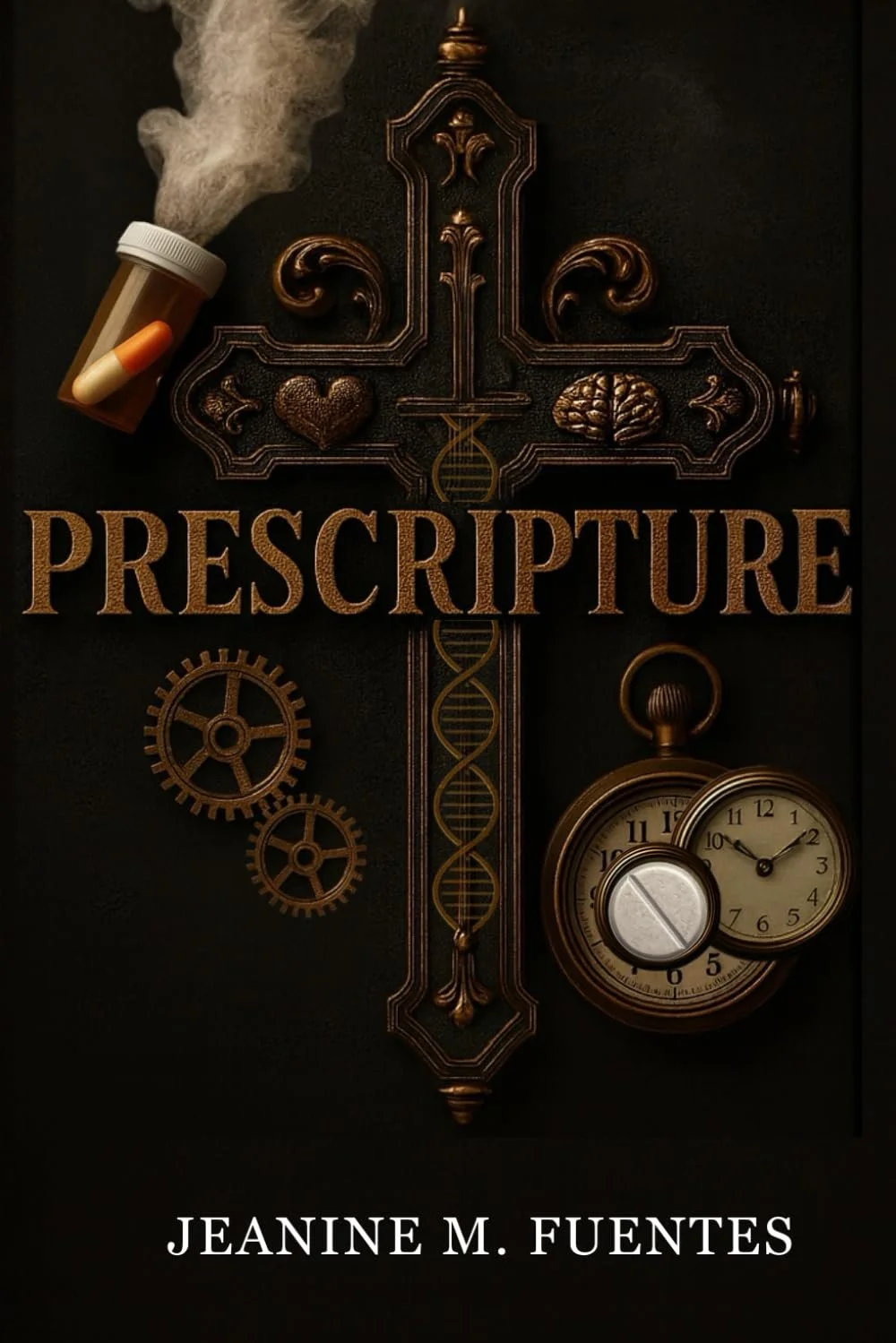
Available for purchase ONLY on AMAZON: Purchase PRESCRIPTURE HERE
Raw, unflinching, and deeply redemptive, PRESCRIPTURE is a soul-baring journey through trauma, faith, and the transformative power of God’s healing. Combining personal testimony with biblical insight, Jeanine Marie Fuentes offers spiritual “prescriptions” for life’s deepest wounds—emotional, mental, and physical.
From the suffocating grip of depression to the ache of father wounds, from the chaos of survival mode to the disorienting search for identity, Fuentes writes with rare vulnerability. Her story unfolds through vivid personal accounts, scriptural parallels, and thought-provoking reflections that invite readers to confront their own hidden pain and conditioning.
Every chapter explores a specific “ailment” of the soul—such as jealousy, stubbornness, spiritual deafness, or the longing for what was missing—and pairs it with biblical antidotes for restoration. “Storytime” segments reveal real-life moments from Fuentes’ journey, making each lesson visceral and relatable.
More than a memoir, PRESCRIPTURE is a spiritual field guide for anyone desperate for change, wrestling with identity, or hungry for God’s truth to rewrite their story. It is an invitation to lay down the labels, surrender the survival patterns, and embrace the fullness of life and purpose in Christ.
This book is for:
Those navigating the aftermath of trauma
Believers seeking to deepen their faith and identity in God
Anyone tired of self-help platitudes and craving honest, scripture-based truth
People ready to exchange shame for freedom and despair for hope
Through every page, PRESCRIPTURE reminds us that nothing is wasted in God’s hands—and that our pain, surrendered to Him, becomes a powerful prescription for healing.
